
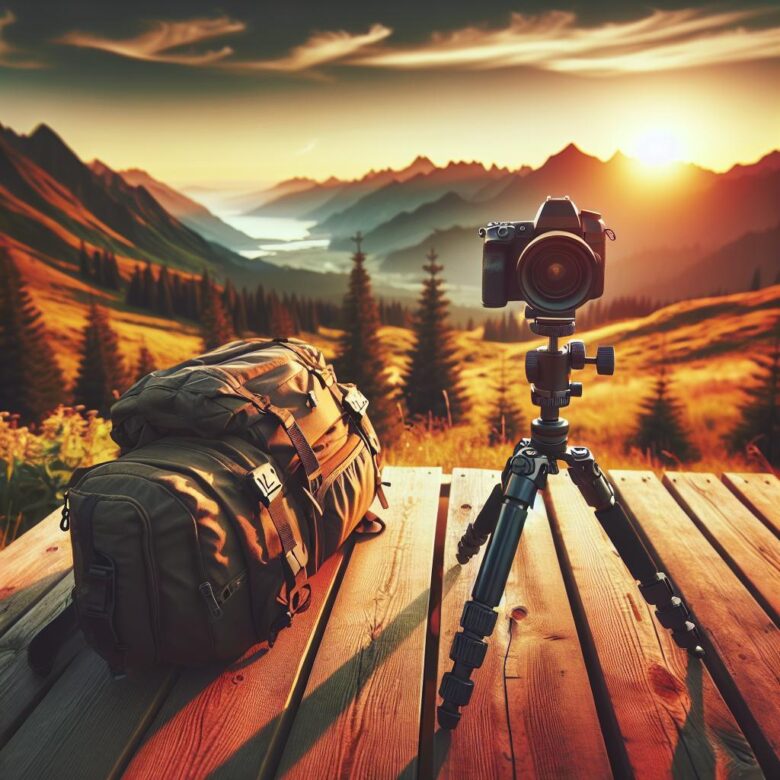
The wrong travel tripod costs landscape photographers more than weight-it costs sharp frames, missed blue-hour light, and wasted miles on the trail. I’ve tested compact tripods in wind, on uneven ground, and in low-light setups where a weak leg lock or flimsy center column ruins the shot fast.
The market is crowded with “lightweight” options that look good on paper but fall apart in real outdoor use. Ignore the differences in stability, packed length, and load handling, and you risk spending premium money on gear that stays clipped to your bag instead of earning its place in the field.
Below, I break down the best lightweight travel tripods for outdoor landscape photography-based on portability, rigidity, real-world usability, and value-so you can choose the right support system without trial-and-error.
How to Choose the Best Lightweight Travel Tripod for Landscape Photography: Stability, Packability, and Load Capacity Explained
Most lightweight tripods fail landscape work for one reason: torsional rigidity drops faster than weight savings improve portability once you extend the center column or use the thinnest leg sections. For full-frame bodies with a 16-35mm or 24-70mm lens, a realistic minimum is a tripod rated at 8-12 kg, not because your kit weighs that much, but because stiffness and damping scale with the margin above actual load.
- Stability: Prioritize larger top leg diameters, fewer leg sections, and no center-column extension in wind; carbon fiber damps vibration better than aluminum, but poor apex design still produces micro-blur at 1/2 to 2 seconds.
- Packability: Folded length matters more than raw weight for hiking efficiency; 40-45 cm fits most carry-on and side-pocket setups, while twist locks generally pack cleaner and snag less than flip locks in brush and rock scrambles.
- Load Capacity: Ignore marketing payload claims unless paired with ball head specs and lens torque; use PhotoPills or a vibration test at 10x live view to verify whether the tripod settles fast enough after composition changes.
Field Note: On a coastal sunrise shoot with a 24MP Sony body and 20mm lens, I cut blur by replacing a compact 5-section travel tripod with a 4-section model of the same weight, dropping settle time from roughly 3 seconds to under 1 after each adjustment.
Carbon Fiber vs. Aluminum Travel Tripods in the Field: Which Saves Weight Without Sacrificing Sharpness on Windy Landscapes?
Tripod blur in windy landscapes is usually a torsional-stiffness problem, not a simple weight problem. A carbon fiber travel tripod typically saves 20-30% over an equivalent aluminum model, but the real field advantage is faster vibration damping after shutter press, leg touch, or gust loading.
| Factor | Carbon Fiber | Aluminum |
|---|---|---|
| Weight-to-stiffness | Better for long approaches; less fatigue means more precise setup on uneven ground | Heavier for the same class, but sometimes comparable static rigidity at lower cost |
| Wind behavior | Damps high-frequency vibration faster, especially with thin travel-leg sections | Can ring longer after gusts or center-column contact; benefits more from added ballast |
| Cold-weather handling | More comfortable bare-handed; less thermal transfer into gloves and locks | Colder to handle, which slows adjustments during dawn and alpine shoots |
Field Note: On a coastal dawn shoot, I verified a 1.6-second decay difference between carbon and aluminum travel legs by reviewing 10x live-view vibration in qDslrDashboard, and the sharper file came from the lighter carbon setup with the center column kept fully down.
Best Lightweight Travel Tripod Features for Outdoor Shooters: Low-Angle Setup, Ball Head Performance, and Fast Deployment Tips
Most missed landscape frames happen during setup, not exposure: a travel tripod that takes 20 seconds longer to deploy can cost the only clean break in moving cloud or surf. Outdoor shooters also overvalue folded length and ignore low-angle geometry, where independent leg spread, removable center columns, and a stable ball head matter far more on uneven ground.
- Low-angle setup: Look for 3-stop leg-angle selectors, split or removable center columns, and legs that splay flat without the apex binding; this keeps the camera inches off the ground for foreground-weighted compositions while preserving torsional rigidity.
- Ball head performance: Prioritize a separate friction control, a panning base with readable degree marks, and an Arca-compatible clamp; under a 16-35mm setup, a good head should settle immediately after lockoff without “droop,” which you can verify later in Capture One by checking sequential horizon consistency.
- Fast deployment: Quarter-turn twist locks usually beat flip locks in sand, brush, and freezing spray because there are fewer snag points; mark one leg as your “front” so you can orient the platform by touch and open the widest section first for faster leveling.
Field Note: On a windy basalt shoreline shoot, switching from center-column extension to a flat-spread low-angle stance eliminated a repeat 1-2 mm composition shift that was causing pano stitch errors in back-to-back frames.
Q&A
-
What should I look for in a lightweight travel tripod for outdoor landscape photography?
Prioritize the balance between weight, stability, packed size, and working height. For landscape work, a tripod that is light but too flexible in wind will quickly become frustrating. Carbon fiber models are usually the best choice because they reduce weight and damp vibration better than aluminum, though they cost more. Check the maximum load rating, but do not rely on that number alone; leg diameter, leg locks, and overall rigidity matter more in real use. A good travel tripod should also have a solid ball head, Arca-compatible plate system, independent leg angles, and a center column that can be removed or kept short for better stability on uneven ground.
-
Is a carbon fiber travel tripod really worth it for hiking and landscape photography?
For most outdoor landscape photographers, yes. Carbon fiber is typically worth the extra cost if you hike regularly, shoot in cold conditions, or carry your tripod for long distances. It is lighter in the pack, more comfortable to handle in low temperatures, and generally better at reducing small vibrations from wind or shutter movement. Aluminum can still be a smart budget option, especially for occasional travel, but it usually becomes less appealing on long treks where every gram matters. If your priority is frequent backcountry use with a full-frame camera and wide-to-midrange lenses, carbon fiber is usually the better long-term investment.
-
Which lightweight travel tripod features matter most in windy outdoor conditions?
In wind, the most important features are thicker leg sections, minimal center column use, strong leg locks, and a rigid head. Many travel tripods become unstable because they rely on a tall center column to achieve height; for landscape photography, that is a weakness. Look for a model that remains usable at a practical height without extending the center column. Twist locks are popular because they are compact and weather-resistant, but the real test is how securely they hold under load. A tripod with a weight hook can help, but hanging a bag only improves stability if the bag does not swing in the wind. For coastal scenes, mountain viewpoints, and long exposures, overall rigidity matters more than having the absolute lightest model available.
Summary of Recommendations
Choose the tripod you will actually carry when the light turns exceptional and the trail gets longer than expected. A slightly less feature-rich model that survives wind, packs fast, and fits your real hiking kit will outperform a “better” tripod left in the car.
Pro Tip: The biggest mistake I still see is buying by weight alone. Check the leg locks, apex rigidity, and packed length before anything else-those three details decide whether your foreground stays sharp at blue hour or turns into a soft, expensive compromise.
Before you close this tab, put your camera, widest lens, and hiking bag on the floor and write down your maximum acceptable tripod weight and folded length. That one number pair will narrow the field faster than any spec sheet.

Dr. Julian Mond is a visual storyteller and researcher dedicated to the intersection of light, history, and human emotion. With a doctorate in Visual Arts, he combines academic precision with a cinematic eye to transform fleeting moments into timeless narratives. Through Mond Photos, he explores the world as a living gallery.